Find out how Aramore NAD+ can transform your skincare routine with its innovative anti-aging solutions.
NAD+ is the sort of molecule that arrives in skincare with a great deal of scientific swagger and not a little theatrical lighting. I have seen plenty of anti-ageing promises dressed up in lab-coat language over the years, but Aramore’s pitch is sharper than most: restore declining NAD+ in skin cells, revive cellular energy, and help ageing skin behave with a bit more vim and less visible sulking.
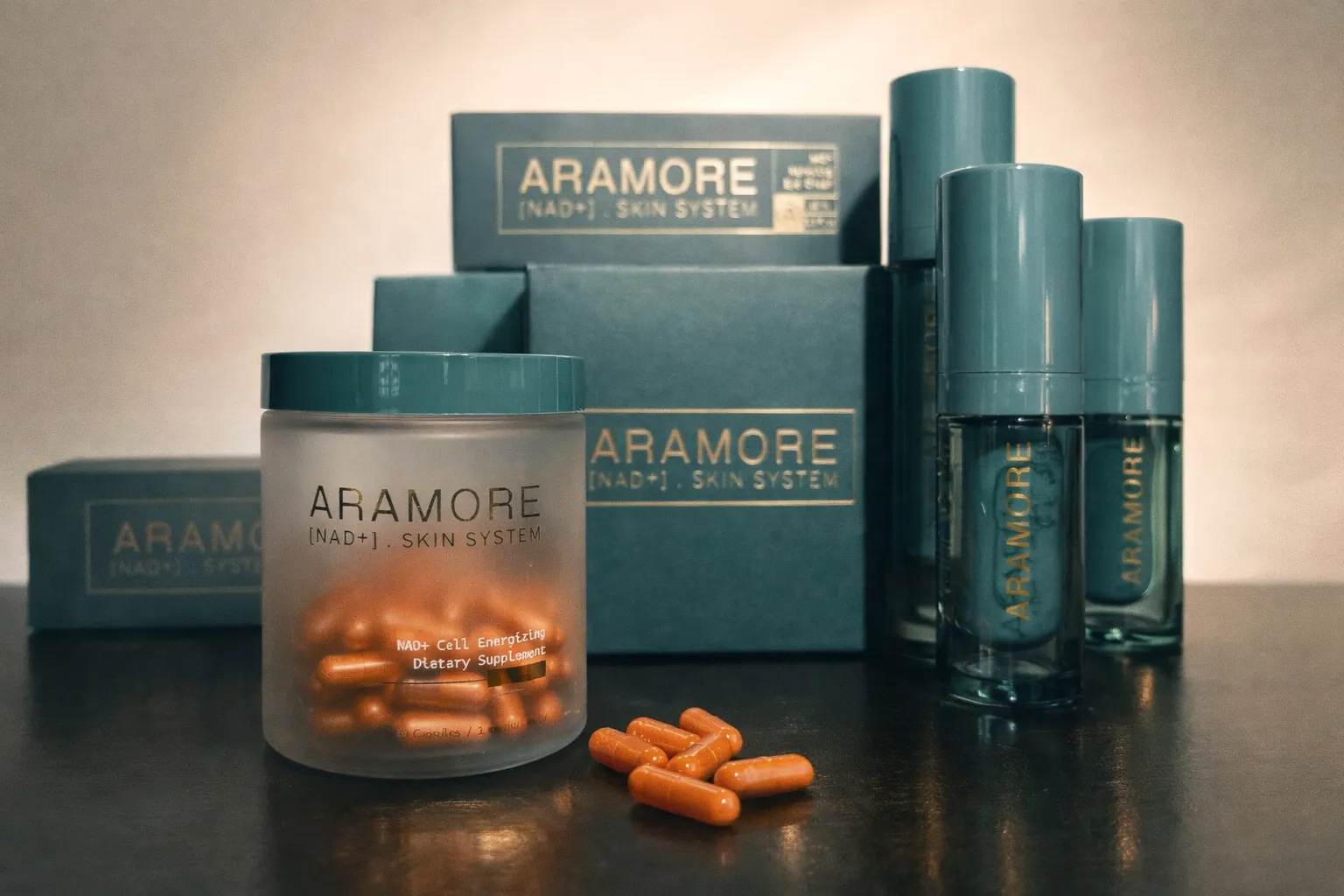
That is the central promise here. Aramore is not merely selling a cream and hoping for the best. It is selling a system — supplements for morning and evening, a daytime lotion, a retinol peptide booster, and a richer night cream — all built around the idea that skin health begins at the cellular level and that NAD+ is the missing spark.
It is an ambitious argument. It is also, on the face of it, more interesting than the usual parade of miracle jars that claim to erase time while barely denting a fine line.
What Aramore Is Actually Selling
What struck me first is that this is not a simple moisturiser story. Aramore wants to own the whole routine.
In the morning, the brand recommends its NAD+ Vitalise Supplement alongside the NAD+ Cell Energising Lotion. In the evening, it shifts to the Restore Supplement, then the Retinol Peptide Booster, followed by the NAD+ Cell Restoration Cream.
That tells me two things straight away.
First, Aramore is leaning hard into the inside-out beauty category, where topical skincare meets nutraceutical support. Second, this is clearly aimed at people willing to commit to a full regimen rather than dabble with one hopeful dab before bed.
For some buyers, that will feel comprehensive. For others, it will feel like skincare with admin.
My First Read on the NAD+ Pitch
The science-led angle is what gives this line its intrigue. NAD+, short for nicotinamide adenine dinucleotide, plays a role in cellular energy metabolism and normal cell function. Aramore’s broader claim is that declining NAD+ contributes to visible ageing and that boosting it in the epidermis can support smoother, brighter, healthier-looking skin.
Now, that is a more compelling framework than the usual “radiance” waffle. It is anchored to something biologically real.
Where Aramore tries to separate itself is in delivery. The brand says NAD+ itself is too large to penetrate skin effectively, so it uses NAD+ precursors and synergistic compounds instead, with niacinamide doing some of the heavy lifting. That, frankly, makes more sense than trying to smear an oversized molecule onto the face and praying it somehow finds its way into the right postcode.
In plain English, the promise is this: feed the skin cells what they need, support skin turnover, improve texture and tone, and intercept ageing earlier in the chain rather than merely polishing the bonnet.
It is clever positioning, and it is not entirely smoke and mirrors.
How This Could Translate to Real Skin
On paper, Aramore’s strongest argument is not that it will magically reverse time. It is that it brings together several ingredients and routines already associated with healthier-looking skin.
Niacinamide has a credible track record in skincare. Retinol remains one of the better-known ingredients for improving texture, lines and uneven tone, though it can also be a cantankerous little devil if overused. Peptides, when well formulated, can help support skin appearance and barrier function. A richer cream layered over active treatment is also sensible.
So the practical benefit of this NAD+ system is not just the headline molecule. It is the architecture of the routine.
Morning appears geared toward hydration, metabolic support and daytime resilience. Evening shifts into repair mode, using retinol and a richer cream to target texture, wrinkles and dullness while skin does its overnight maintenance.
That is coherent. I like coherent.
Where Aramore Looks Strong
The best thing about this range is that it does not rely on one heroic ingredient doing all the work while the rest of the formula stands about admiring itself.
There is a sensible split between AM and PM use. There is a clear emphasis on skin renewal. There is attention to mature skin without boxing the line into a narrow age category. There is also an encouraging focus on clean formulation standards, with the products described as fragrance-free, vegan, hypoallergenic, dermatologist-tested and cruelty-free.
Aramore also says the topical products and supplements complement one another, and that is probably where the brand sees its edge. In a crowded anti-ageing market, bundling cellular energy, skin barrier support, retinol renewal and internal supplementation into one joined-up routine gives it a stronger identity than another anonymous “lifting” cream in a glossy pot.
The clinical note helps too, though with caveats. The brand points to an eight-week human clinical trial involving 30 healthy female participants aged 40 to 69 using the NAD+ Cell Restoration Cream and Retinol Peptide Booster. That is better than no testing at all.
It is not Mount Sinai carved in stone, but it is at least a proper attempt at evidence.
Where I’d Still Be Cautious
This is the part where the band stops playing and the lights come up.
The clinical trial is small. Thirty participants is not nothing, but it is not exactly a sweeping body of evidence either. It also appears to focus on two products rather than the full Aramore line, so any claims about the entire system should be treated with a calm eyebrow rather than blind devotion.
Then there is the matter of irritation. The brand itself notes that the Energising Lotion may cause tingling and that the Retinol Peptide Booster can lead to peeling, redness and sun sensitivity if not used properly. None of that is unusual for active skincare, but it does mean this is not a carefree slap-it-on-and-go line for sensitive skin.
The regimen is also fairly involved. Supplements twice daily, multiple topicals, patch testing, sunscreen, careful night-time use of retinol — all sensible, yes, but not exactly a low-maintenance affair. Anyone hoping for one tidy product and a miracle may find themselves staring at the bathroom shelf like a man trying to assemble flat-pack furniture without the instructions.
And there is one more limitation: without pricing, I cannot fully judge value. A premium skincare system has every right to cost more if the formulas, tolerability and results justify it. But value is not science alone. Value is science plus outcome plus consistency plus what it asks of your wallet over time.
What It Feels Like Aramore Is Best At
If I strip away the marketing mist, Aramore appears strongest in three areas.
First, it gives the anti-ageing conversation a more biologically literate backbone through NAD+, cellular energy and precursor delivery.
Second, it combines familiar skincare workhorses — especially niacinamide and retinol — with a broader wellness angle.
Third, it is clearly built for people who take skincare seriously and are willing to follow a structured routine rather than chase instant miracles.
Compared with standard anti-ageing creams that lean on one or two familiar actives and some vague talk of glow, this feels more targeted and more system-driven. Whether that makes it better in practice depends on tolerance, consistency and price, but it certainly makes it more distinctive.
Pros and Cons
Pros
Aramore has a clear point of difference in the NAD+ story rather than generic anti-ageing waffle.
The routine is thoughtfully split into morning and evening phases.
Niacinamide, retinol and peptide support give the range more substance than a trendy headline alone.
The formulas are positioned as clean beauty friendly, with dermatologist-tested, hypoallergenic and vegan credentials.
The inside-out approach will appeal to buyers who like skincare and supplements working together.
Cons
The clinical evidence cited is still relatively limited.
The full regimen is quite demanding and may be too much for minimalist users.
Retinol and active formulas may not suit sensitive or reactive skin.
Tingling, peeling and irritation are openly acknowledged risks.
Without pricing, the value case remains incomplete.
Who Is This Best For?
I would say Aramore is best suited to people in their 30s and beyond who are beginning to notice changes in skin texture, firmness, hydration and tone, and who are willing to be disciplined.
It also makes sense for skincare users who already understand actives and are comfortable with niacinamide, retinol and structured day-night routines.
If your skin is very sensitive, if you dislike multi-step regimens, or if you want instant visible transformation from a single product, this may be a less comfortable fit. There is enough potency here to demand some respect.
Is It Worth It?
On concept alone, yes, Aramore looks more credible than a lot of anti-ageing fare that arrives wrapped in nonsense and smelling faintly of disappointment.
The NAD+ angle is interesting. The use of precursors rather than the molecule itself is sensible. The pairing of topical skincare with supplements gives the range a fuller logic. And the combination of niacinamide, retinol and restorative support suggests this is not just scientific wallpaper over a mediocre formula.
But worth it is a dangerous phrase in beauty. It depends on price, patience and skin tolerance. If Aramore is priced competitively within premium skincare, and if users can tolerate the active formulas, there is a decent case for it. If it is priced like a moon landing, then the evidence needs to be broader and the results need to sing louder.
My verdict is that Aramore has more substance than hype, but not enough independent proof to be treated as gospel. In a market full of over-perfumed nonsense and empty promises, that still puts it in relatively good company.
NAD+ may not be a magic wand, but in Aramore’s hands it looks like a genuinely intelligent anti-ageing angle — provided you go in with clear eyes, steady expectations and a healthy respect for sunscreen.