La Roche-Posay Racing Team faces its first Cagliari test as the America’s Cup cycle begins in Sardinia.
The America’s Cup cycle takes its first proper competitive breath in Cagliari this week, and for the French La Roche-Posay Racing Team, Sardinia is less a postcard than a lie detector strapped to an AC40.
Sardinia Sets The Stage For The First Proper Test
Starting Thursday, May 21, the Louis Vuitton 38th America’s Cup Preliminary Regatta Sardinia brings eight AC40s onto the Gulf of Angels for a short, sharp examination of speed, nerve and communication.
There will be one official training day, followed by three days of racing. Up to eight fleet races are scheduled before a match-race final between the top two crews.
It is not a points-scoring event for Naples 2027. No one leaves Cagliari with the America’s Cup halfway into the trophy cabinet. But that does not make it soft.
This is the first time the French team led by Quentin Delapierre will measure its new shape against the fleet it expects to see through the 38th America’s Cup cycle. Training is one thing. Training with seven other boats hissing about the place like angry cutlery is quite another.
From Lorient Solitude To Fleet-Racing Pressure
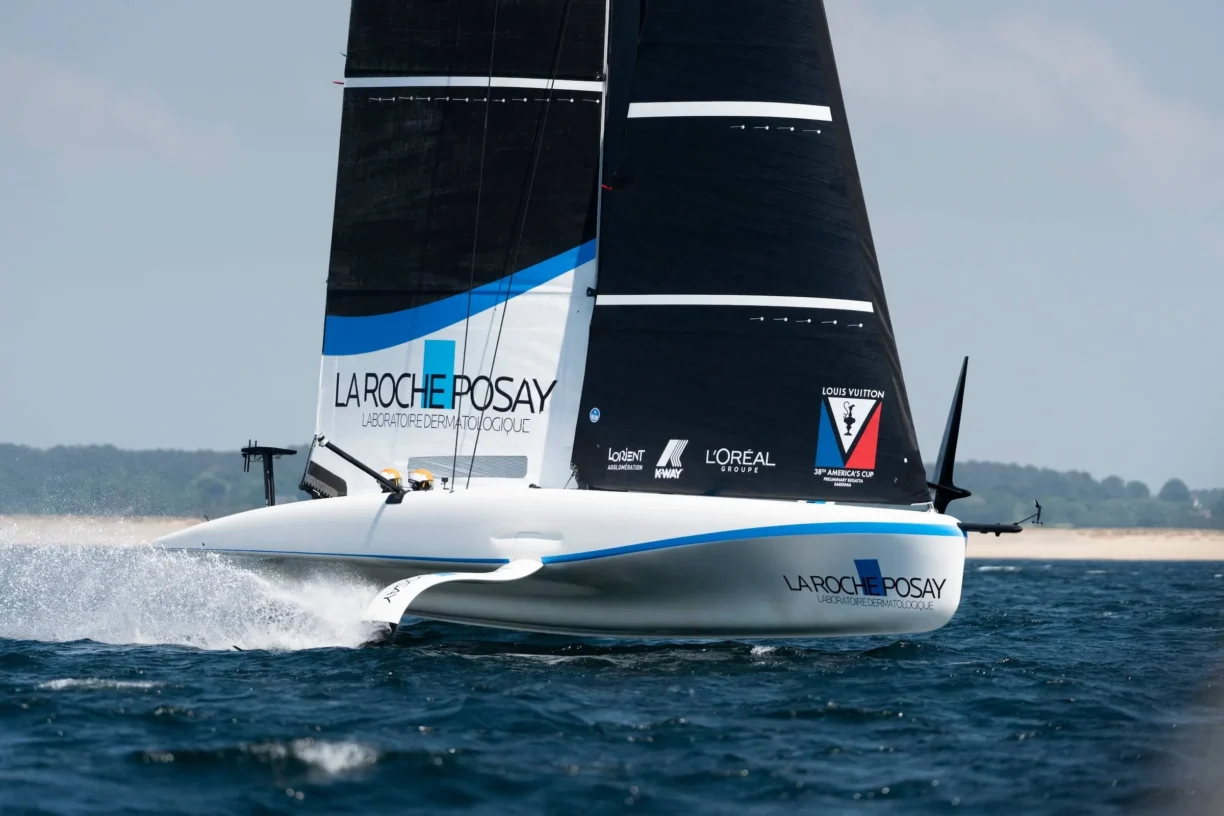
La Roche-Posay Racing Team arrives after an intense spell in Lorient, where the work was private, repetitive and necessary: manoeuvres, timing, communication, boat feel, sailing modes, and the sort of team language that tends to be built in sweat rather than slogans.
The team logged 19 sailing days, with at least three hours on the water each day. That gave the crew time to study the AC40 in different conditions, but largely without the aggravation of rival boats squeezing space, forcing decisions and turning the starting line into a floating chessboard played at motorway speed.
Quentin Delapierre, skipper and helmsman of La Roche-Posay Racing Team, said: “This is our first real milestone with our new crew. In Lorient things came together really well, and the six of us feel comfortable together. We completed some very strong training blocks, but alone in Lorient we were a bit like kings of the track. Here, it’s a reality check. The goal is to apply in the racing, with all the competitors around us, everything we learned on our own.”
That line about being “kings of the track” is the sort of honesty sport could use more of. Every team looks smooth when there is nobody elbowing them into a corner.
Philippe Presti, the sporting director of La Roche-Posay Racing Team, said: “We have a different approach because we trained alone. We focused on ourselves, our manoeuvres, our strategy, and our performance. The first few days will allow us to draw conclusions, adapt, and keep improving. That’s the most important thing.”
Why Cagliari Matters Without Offering Points
Cagliari will not alter the final standings of the 38th America’s Cup. It will, however, reveal plenty.
Fleet racing in AC40s asks different questions from isolated training. How sharp are the starts? How clean are the manoeuvres under pressure? How composed is the crew when space disappears? How quickly does the boat recover through transitions? Who has speed, and who merely looked fast when nobody was watching?
For La Roche-Posay Racing Team, this is not about a decorative early ranking. It is about evidence.
Every start, crossing and mistake becomes a data point. Every awkward moment tells the performance department where the next hour, day or month of work should go.
The Gulf Of Angels Will Not Be Decorative
The Gulf of Angels may sound like a place designed by a tourism board with a weakness for soft lighting, but Cagliari is expected to have teeth.
The racecourse layout is described as fairly standard, yet eight AC40s on the same line changes the geometry instantly. Less room. More traffic. Sharper crossings. A starting phase with the tension of a match-race box and the added spice of multiple boats arriving with the same bright idea.
The first days in Sardinia have already offered a useful reminder that the Mediterranean can be moody. The French team arrived late last week and initially found too much wind, before sailing on Sunday, Monday and Tuesday in very light breeze.
The outlook suggests sunshine, southerly airflow and probable sea state. For an AC40 — fast, reactive and wonderfully unforgiving — rougher water can make transitions, flight phases and manoeuvres feel like trying to thread a needle while falling down stairs.
Philippe Presti: “The race area is fairly classic, but with eight boats there will be less room. The starting phase is a bit larger, fairly close to a match-race box. Over the weekend there will probably be some sea state, and we’re happy to have sailed in those conditions in Lorient.”
Delapierre sees the value in that preparation.
Quentin Delapierre: “The conditions in Lorient were exceptional. We had a lot of high-quality hours on the water and were able to cover the full range of techniques we wanted to test, both in terms of our own needs and the work of the performance department. Training alone also has advantages: it allows you to learn how to feel your boat, recognise the sensations that generate speed, and focus the whole team on a single objective.”
Inside The AC40: Four Minds, One Moving Problem
The AC40 does not reward romantic improvisation. It rewards precision.
On board, the roles are tightly defined: two helmsmen, two trimmers. Each sees part of the race, controls part of the boat and feeds into a chain of decisions. At these speeds, one late call can become a tactical tax bill with interest.
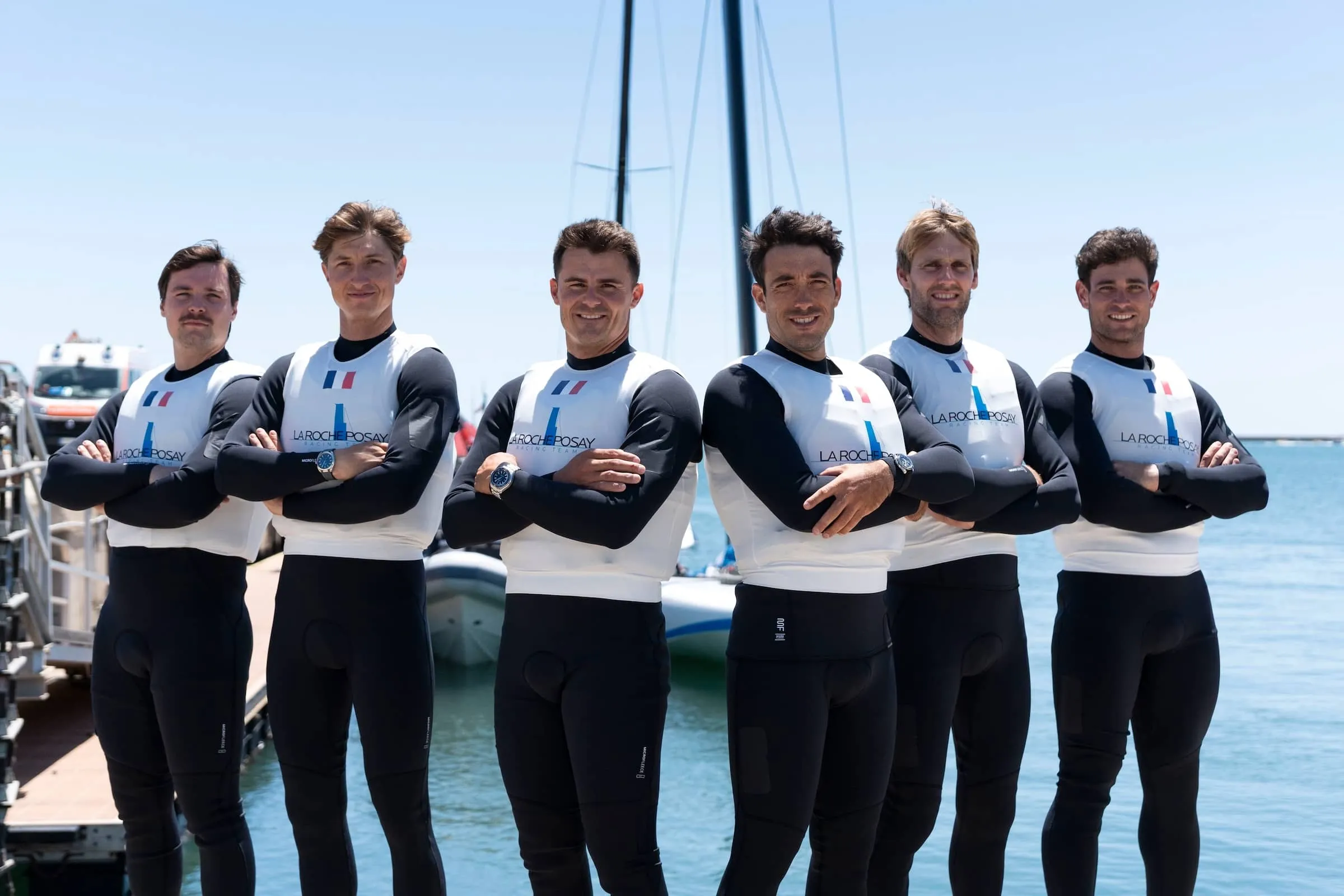
For this preliminary regatta, La Roche-Posay Racing Team will field Quentin Delapierre and Diego Botín as helmsmen, with Jason Saunders and Florian Trittel as trimmers. Enzo Balanger, helmsman, and Timothé Lapauw, trimmer, complete the group as reserve athletes.
The selection blends continuity from the 2024 campaign, through Delapierre and Saunders, with the arrival of Diego Botín and Florian Trittel, Olympic champions who now step into the AC40 environment.
Philippe Presti: “With around twenty days on this boat, we had to establish reference points quickly. We organised the boat by maintaining continuity with those who already had experience in certain positions, while integrating Diego and Florian. We worked on manoeuvres, starts, communication, timing, but also on the ability to build decisions as pairs and as a group of four.”
That last phrase matters. This is not one sailor making a heroic decision while everyone else hangs on and hopes. The boat is too fast, the margins too thin and the consequences too immediate.
Quentin Delapierre puts it plainly.
“The start is really built by two and by four. If Diego doesn’t give me the tack exactly in the right place, things become very complicated. And if the tack is good but I don’t correctly apply our strategy in the final phase, it’s just as complicated. We spend a lot of time working on our timing and discussing these sequences.”
A Regatta Built For Learning, Not Chest-Beating
La Roche-Posay Racing Team knows some opponents arrive with more time on the water. Some have trained with two boats. Some may have more direct comparative data already in the bank.
The French team’s route has been different: more inward-looking, more process-driven, more focused on its own sensations, systems and reference points.
That makes Cagliari especially valuable. The team will not just find out whether it can go quickly. It will find out whether it can think quickly.
Philippe Presti: “The America’s Cup is made up of big machines. You have to learn how to put yourself under fire, see how the organisation reacts, and improve from those situations. This regatta is one of the rare opportunities to put everyone into real confrontation.”
Delapierre also sees a broader shift in the team’s development since the previous campaign.
Quentin Delapierre:“Compared to the start of the previous campaign, the team has really taken a major step forward. The arrival of Philippe Presti, Philippe Mourniac, Lucas Delcourt, Diego Botín, and Florian Trittel changes a lot of things.
We worked extremely well in Lorient, dissecting manoeuvres, the feel of the boat, and making sure we are all on the same page. On the eve of Cagliari, I am reasonably confident. We have very good feelings onboard, and above all we are excited to race against eight boats.”
Eight Teams, One Crowded Line
The entry list gives this preliminary regatta proper competitive texture.
The teams entered are:
New Zealand – Emirates Team New Zealand
New Zealand – Emirates Team New Zealand: Women & Youth
Great Britain – GB1
Great Britain – Athena Pathway: Women & Youth Team
Italy – Luna Rossa 2
Italy – Luna Rossa 1: Women & Youth Team
Switzerland – Tudor TeamAlinghi
France – La Roche-Posay Racing Team
For the established names, Cagliari is a chance to sharpen. For younger and developing crews, it is a chance to accelerate learning under the harshest possible spotlight: other boats, limited room and no hiding place once the start sequence begins.
How To Watch The Louis Vuitton 38th America’s Cup Preliminary Regatta Sardinia
The regattas will be broadcast live from 3:00 p.m. CEST on the official America’s Cup website and the competition’s official YouTube channel.
Replays will be available after the races.
For La Roche-Posay Racing Team, Sardinia is not supposed to produce a finished article. It is supposed to expose the draft. And in the America’s Cup, that is often where the real work begins — not in the clean run, but in the messy corner where speed, pressure and judgement all arrive at once.