Apple Heart and Movement Study data compares pickleball vs tennis on Apple Watch, revealing workout intensity, duration, mood signals and growth trends.
Pickleball may look like tennis that’s shrunk in the wash, but Pickleball is now officially big enough for Apple’s boffins to start poking at it with spreadsheets. In the latest update from the Apple Heart and Movement Study, the world’s fastest-growing bat-and-ball soap opera steps into the spotlight – and the numbers say this upstart is very good news for your heart, your head and, apparently, the state of Utah.
From Sidewalk Game to Scientific Subject
Researchers wanted to know how this emerging sport stacks up against its older, snootier cousin, tennis – not in fashion points, but in cold, hard data on health. So they did what Apple does best: turned to the watch on your wrist.
In one of the largest observational datasets of pickleball activity collected using Apple Watch, scientists sifted through more than 250,000 pickleball and tennis workouts from over 200,000 participants across the US. The goal: work out how long people are playing, how hard they’re working, and what it might be doing to their health over time.
“The Apple Heart and Movement Study offers us remarkable opportunities to follow participants’ behaviour changes and the consequences of these changes on health,” said Calum MacRae, M.D., PhD, a cardiologist, Professor of Medicine at Harvard Medical School, and principal investigator of the Apple Heart and Movement Study at Brigham and Women’s Hospital.
“Following the growth of pickleball using Apple Watch data allows us to explore emerging trends and the effects of activity on multiple metrics of health and wellness that were not accessible before.”
In other words: we’ve gone from guessing what’s good for you to actually measuring it, one sweaty wrist at a time.
Longer Rallies, Different Engines

First up, the basics. When researchers lined up pickleball versus tennis on court time, the paddles edged it. On average, pickleball workouts ran to 90 minutes, while tennis sessions clocked in at 81 minutes – not exactly a walk on, wave, and walk off. Both sports kept people moving for long stretches.
Intensity told a slightly different story. Using heart rate data from Apple Watch, the study showed tennis players hitting a higher average peak heart rate of 152 beats per minute, compared with 143 beats per minute in pickleball. That’s a nine-beat advantage to tennis on the “how much is your heart thumping?” scale.
Heart rate zones confirmed the pattern. While both sports followed similar trends across intensity zones, tennis workouts had nine percentage points more time spent in those higher-intensity zones than pickleball workouts. So if tennis is the sport slamming its foot down on the accelerator, pickleball is more like cruising the motorway in sixth gear – a steady hum rather than a red-line roar.
Crucially, players in both camps were averaging a peak heart rate within 70 percent of their estimated max during recorded workouts. That’s right in the sweet spot where regular physical activity is linked with better quality of life and healthy ageing – whether you’re swinging a racket or a paddle.
Pickleball: Good for the Heart, Easy on the Head
Exercise isn’t just about VO₂ max and bragging rights. The scientists also looked at mood, using an optional mental health questionnaire called the Patient Health Questionnaire-2 (PHQ-2), a quick screening tool for signs consistent with depressed mood.
Across the study, results suggesting depression were rare. But among those who repeatedly hit the courts, the picture looked even brighter. The distribution of PHQ-2 scores was lower among frequent pickleball and tennis players than the general participant pool.
The odds of PHQ-2 results suggestive of depressed mood were 60.1 percent lower among frequent pickleball players and 51.3 percent lower among tennis players than the general participant pool, reinforcing the potential benefits of physical activity on mental wellbeing.
“Research is a vital component to our work in health at Apple, and it’s important to see the science behind the mental and physical benefits of activities like pickleball and tennis on Apple Watch users,” said Sumbul Desai, M.D., Apple’s vice president of Health.
“Physical inactivity is a modifiable risk factor for cardiovascular disease and a number of other chronic conditions. Finding an activity that someone enjoys partaking in can help build a routine, whether that means picking up a paddle or a racket.”
Translation: if you can make movement feel like play instead of punishment, your body and your brain will both send you thank-you notes.
Pickleball Surges Past Tennis – and Utah Leads the Charge
The data also doubled as a popularity contest. According to the study, July 2023 was the watershed moment when the number of participants playing pickleball in a single month overtook those playing tennis for the first time.
Tennis workouts showed familiar seasonal swings – more action when the weather behaves, fewer serves into the wind and rain. Pickleball, by contrast, just kept climbing, a relatively steady upward line that makes it look less like a fad and more like a lifestyle.
Geographically, one state strutted onto centre court. Utah came out as the most pickleball-obsessed state per capita in the study, with just over one in every 16 participants giving the sport a go at least once.
“We’re excited to see that in the latest research study update from the Apple Heart and Movement Study, Utah stood out as the most popular state per capita for pickleball. It’s awesome that so many Utahns are grabbing the opportunity pickleball offers to incorporate activity into their days, and this research is a great reminder that exercise of any kind is a powerful way to improve our health over the long term,” said Spencer J. Cox, Utah’s governor.
When your governor is basically cheerleading your dink shots, you know a sport has arrived.
Who’s Playing: Older, Keen, and Often Female
The study also sketched out who’s actually stepping onto court. Both pickleball and tennis workouts were popular across all adult age groups, and in both sports men outnumbered women overall.
But there’s a twist in the tale. On average, players who logged at least 10 pickleball workouts were older than their tennis counterparts – 51 versus 45 years old – and pickleball also showed higher female participation rates in that regular-player group.
That combination – slightly older, more women, long sessions at moderate-to-high intensity – helps explain why Pickleball is so often pitched as a sport that genuinely works for all ages and abilities rather than just the Lycra-clad and ligament-blessed.
“Science Behind Pickleball” – the Governing Body Weighs In
The sport’s own leadership is understandably delighted to see real-world data backing up what enthusiasts have been shouting over the net for years.
“We are pleased to see pickleball-related findings included in the Apple Heart and Movement Study, in collaboration with Brigham and Women’s Hospital and the American Heart Association.
There are numerous benefits for individuals of all ages and backgrounds on the pickleball courts as part of a healthy, social, and active lifestyle,” said Mike Nealy, USA Pickleball’s chief executive officer.
“As the sport’s national governing body in the United States, it’s increasingly meaningful to see science behind pickleball using real-world data from Apple Watch.
The relatively low-impact, informal, and social nature of pickleball can offer a useful and enjoyable outlet for those looking to increase movement and add to their workouts.”
In other words: it’s not just a trendy pastime with a funny name – there’s now data to back up what players feel in their legs and lungs.
Inside the Apple Heart and Movement Study
All of this lives inside the Apple Heart and Movement Study, one of three large public research projects Apple runs through its Research app in partnership with leading institutions.
The Apple Heart and Movement Study, a collaboration with Brigham and Women’s Hospital, the American Heart Association, and Apple, explores the links between physical activity and heart health and has more than 200,000 participants across the United States who have given their consent to share data.
The Research app itself lets scientists dramatically widen the scope and scale of studies like this, turning everyday Apple Watch activity and sensor data into long-term insights on heart health, mobility and behaviour change. That, in turn, helps Apple build new health features grounded in actual science rather than wishful thinking.
Observing participant behaviour, coupled with activity and sensor data from Apple Watch, helps advance researchers’ understanding of factors affecting heart health and mobility over time.
How to Turn Apple Watch into Your Pickleball Partner
Of course, this is Apple, so the story doesn’t end at the lab door. If you’re already hooked on Pickleball – or thinking of joining the paddle-wielding masses – the company is keen to show you how your watch can play along.
Tracking your game
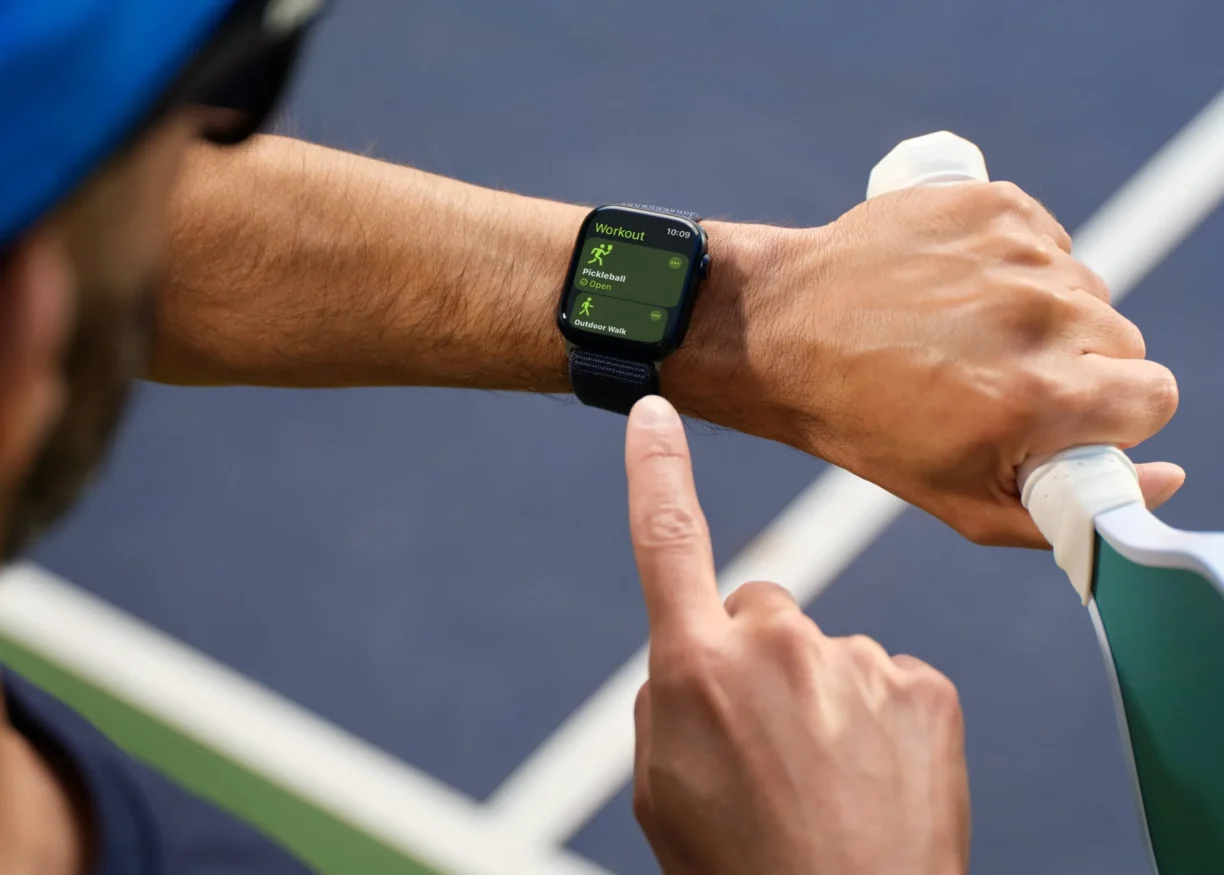
To track pickleball sessions on Apple Watch, go to the Workout app and choose Add Workout, then select Pickleball. To help track workout intensity, users can also customise their Workout views on Apple Watch to include Heart Rate Zones. Users can review their activity data in the Fitness app on iPhone or health data in the Health app on iPhone or iPad.
Staying hands-free on court
With the new double-tap gesture coming later this month to Apple Watch Series 9 and Apple Watch Ultra 2, users can answer and end a phone call or reply to a message with one hand while on the court, while the other hand is holding their paddle.
Protecting your focus (and your sanity)
To stay in the zone, users can create a custom Focus on their iPhone to choose when they want to receive alerts and notifications on Apple Watch, while letting other people know when they’re busy. In Settings, choose Focus, tap the Add button, and then choose Custom to tailor the options.
Leaving the wallet and still buying the coffee
By setting up Apple Pay on Apple Watch, users can leave their wallets at home and pay right from their wrist.
Never losing the kit bag again
Users can slip an AirTag into their pickleball bag and track its location right on Apple Watch. Go to the Find Items app, and choose whether to play a sound or pull up directions to find the item.
So where does all of this leave us? Tennis still brings the higher-octane heart rates; Pickleball brings longer sessions, older players, strong mental-health signals and a growth curve that looks like a rocket launch. Whichever you choose, your heart – and now your Apple Watch – will be keeping score.