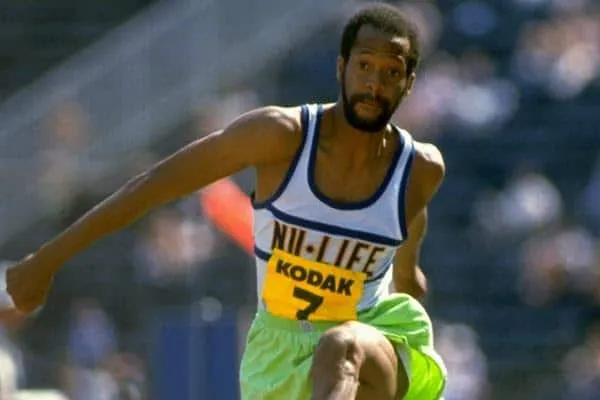
Along with the donated singlet and number, the Heritage Collection has gratefully been given a bag of sand which Banks took from the pit after the competition.
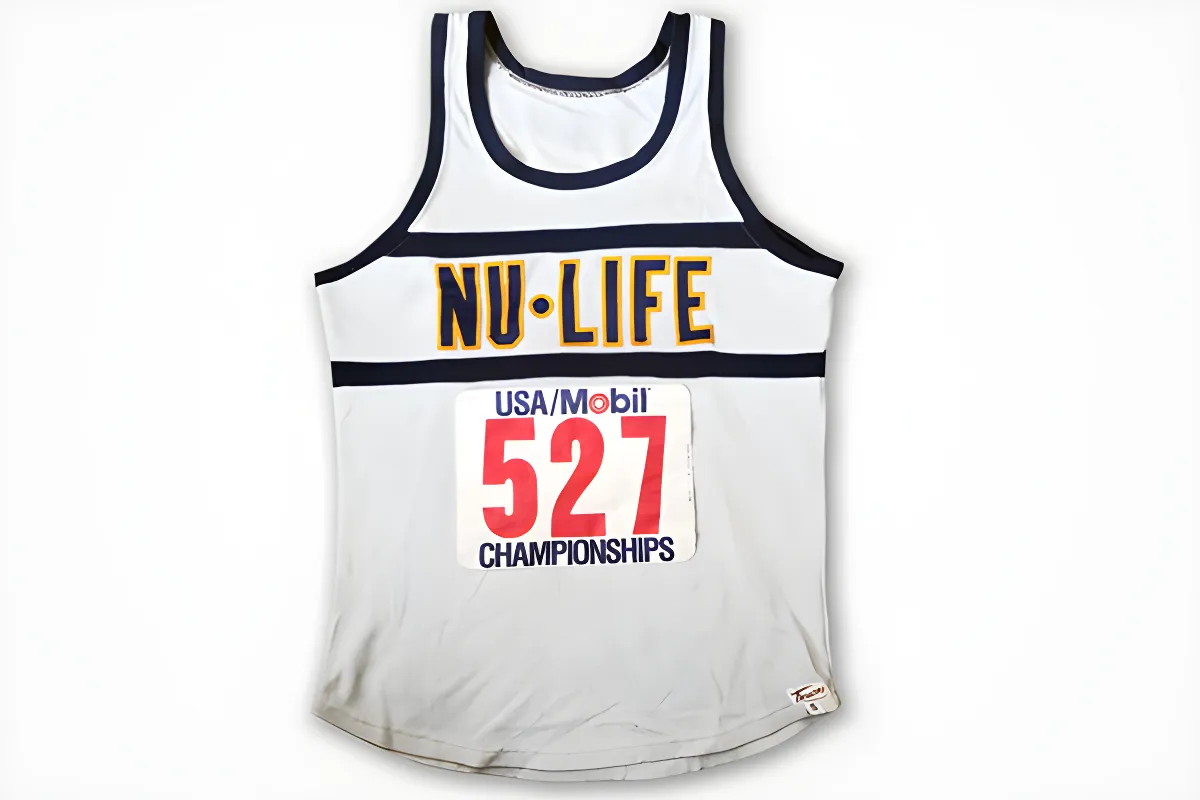
Willie Banks has handed athletics a small but wonderfully evocative parcel of history: the singlet and bib number he wore in 1985 when he set the triple jump world record, plus a bag of sand taken from the pit after the competition.
It is hard to imagine a more literal souvenir from a day when a man jumped into the record books and then, quite sensibly, kept a bit of the landing area.
A World Record With Its Own Time Capsule
The donation has been made to the World Athletics Heritage Collection, and it tells a story far bigger than fabric, paper and sand.
Banks, now a World Athletics Council Member, produced his landmark leap at the US Championships in Indianapolis on 16 June 1985. In the second round, he bounded out to 17.97m, helped by a legal following wind of 1.5m/s. That added eight centimetres to the previous world record, set by Brazil’s Joao Carlos de Oliveira a decade earlier at the Pan American Games.
It was a jump with staying power. Banks’ mark lasted 10 years before Britain’s Jonathan Edwards finally moved the record on by a single centimetre in Salamanca in 1995. One centimetre. The sporting equivalent of losing an argument to a tape measure.
The Feeling Before Flight
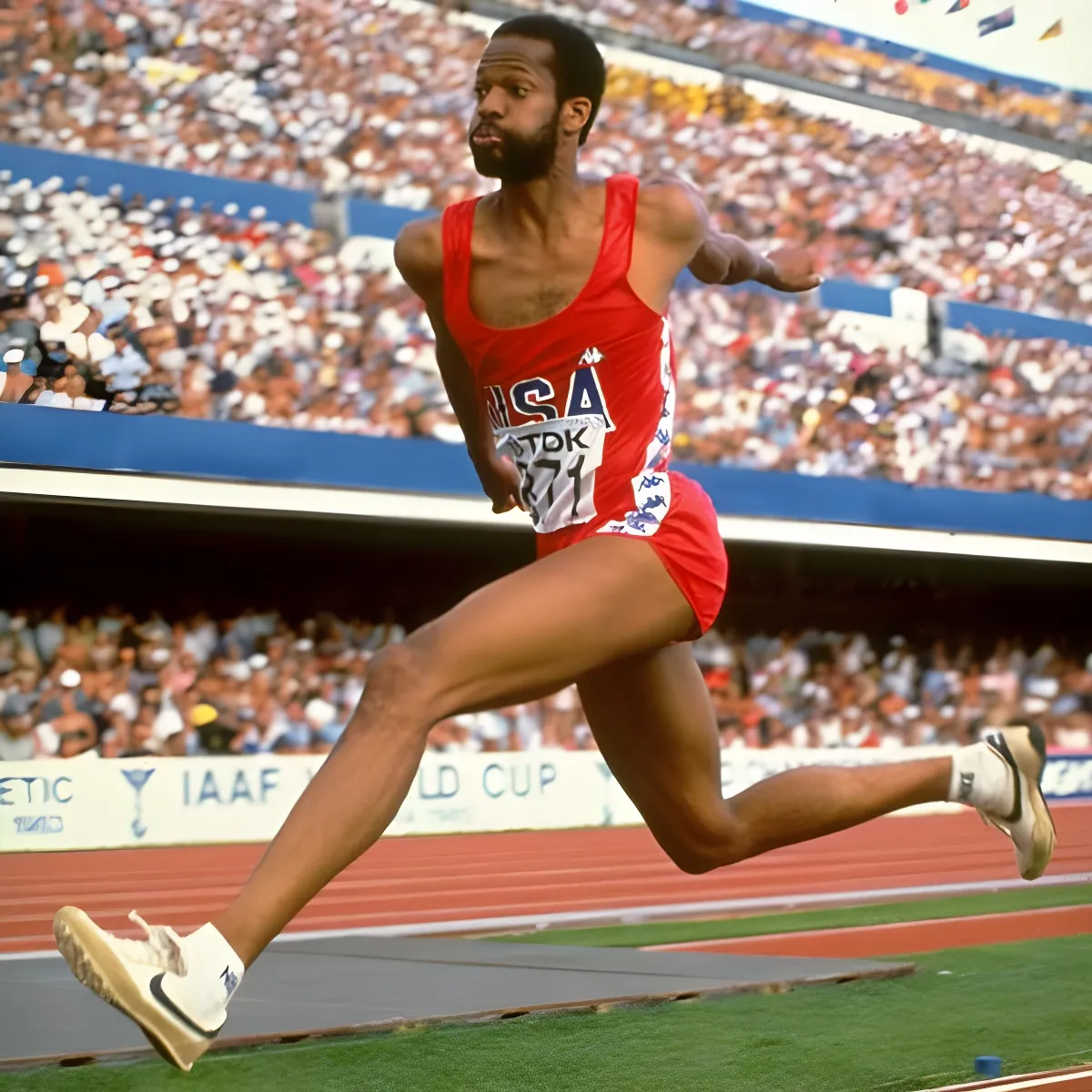
Banks did not stumble accidentally into greatness. By his telling, he knew the record was coming before the take-off board ever entered the conversation.
“I knew that I was going to break the record before I did it,” commented Banks recently. “I had told three people that I would break the record before the jump, right after my first attempt (17.37m). I told my friend Lee Balkin, a high jumper. I also told one of my triple jump competitors and a judge at the triple jump board.
“I knew because a special feeling came over me while I was trying to stay loose for my next jump. I closed my eyes and watched myself do the triple jump. I realised that God had sent me a sign that I was going to break the record and that belief carried me to 17.97m.”
There are athletes who talk about process. Banks talks about premonition. Either way, the result was the same: hop, step, jump, immortality.
The Three Centimetres That Would Not Behave
For all the glory of 17.97m, Willie Banks was left with one tiny, maddening omission. He had not gone beyond 18 metres.
“Actually, I thought I would break it again soon afterwards,” he said. “It was a little frustrating not to be able to jump over 18 metres and I really wanted to be the first to break that barrier. Three centimetres!”
For most mortals, three centimetres is the sort of distance lost to poor posture or an optimistic haircut. For Banks, it became a number with almost comic cruelty.
“My favourite number was always 3,” he added. “I am William Augustus Banks III; I was born in March, the third month of the year; and I was a triple jumper! Why, then, did I miss my mark by three centimetres!?”
The universe, one suspects, has never been above a little teasing.
Beyond 18 Metres — But Not Into The Record Book
Banks did eventually pass the 18-metre line. In fact, he did it twice on the same day.
Back in Indianapolis on 16 July 1988, he jumped 18.06m and then 18.20m. The problem was the wind. At 4.9m/s and 5.2m/s respectively, the readings were well above the 2.0m/s limit allowed for world-record purposes.
So the barrier was broken, but not officially claimed. A little like seeing the gates of Valhalla and being told the paperwork is in the wrong tray.
“I truly thought that I could jump over 18m,” he said. “After that day in 1988, my achilles in both legs bled through to the sheath and attached itself. I could not train properly for the rest of my career. I had three surgeries, but none helped. It was quite a let down from a glorious carrier.
“Fortunately, I am still able to look back and be proud that I was the first human ever to surpass 18 metres in any condition,” he added. “All I can say is I am blessed.”
That last line carries the weight of a man who knows both sides of elite sport: the roar of the crowd and the private negotiation with a body that has given everything and then started charging interest.
The Man Who Made The Crowd Part Of The Jump
Banks was never merely a number on a results sheet. During the 1980s, he became one of the most exuberant figures on the international circuit, a showman in spikes who understood that athletics could have rhythm as well as measurement.
He encouraged spectators to clap in time as he came down the runway. Today, that feels almost built into the sport’s furniture. Back then, it helped change the temperature of track meetings. The triple jump, usually treated by casual spectators as a complicated negotiation with gravity, suddenly had a pulse.
His championship record, as the source material notes, did not fully reflect his immense talent. Yet there were still grand stages and fine rewards. In 1985, the same year as his world record, Banks won at the IAAF World Cup in Canberra on 4 October.
Two years earlier, on 8 August 1983 in Helsinki, he jumped 17.18m to win silver at the inaugural IAAF World Championships. The donation announcement commemorates that anniversary, adding another neat loop to a career already full of symmetry, near-misses and numbers that seem determined to tell their own story.
Why The Donation Matters
The World Athletics Heritage Collection is not simply gathering old kit for glass cases and polite labels. At its best, sporting heritage does something more useful: it gives future generations something to hold in the imagination.
A singlet can tell you who wore it. A bib can tell you when. A bag of sand, though, tells you where the body landed after everything had gone right.
“Soon after being elected to the Council in Doha last September, I visited the Heritage World Championships Exhibition in the city,” he says. “It was at that moment that I realised how fortunate we are to have a programme which is protecting, promoting, and enhancing our sport’s heritage. That is why I decided to play my part and make this donation.”
It is a fitting gesture from an athlete whose influence was never confined to the tape. Willie Banks gave triple jump theatre, rhythm, personality and one of the great records of the modern era.
Now he has given away the uniform of the day itself, along with a little Indianapolis sand. Some athletes leave footprints. Banks, ever the stylist, saved the landing pit.